



Aggregate Reduction in ABS Emulsion Polymerization Process
Although new production processes continue to be developed in response to increasing demand and more diverse quality requirements, emulsion polymerization remains the major ABS polymerization process because it can accommodate products with a variety of qualities. The process involves many complex production steps and requires continued improvement. Because ABS emulsion polymerization is prone to generating aggregates (floc), mixing is a key consideration for aggregate reduction and ABS polymerization process improvement.
CHALLENGES
Agglomerates, Clogging, and Reactor Fouling in ABS Polymerization
- Aggregates, or fouling in the mixing vessel, lower product yield and cause clogging and inefficient cleaning work.
- The dispersion of small particles can deteriorate the working environment.
SOLUTIONS
Mixer Capabilities for ABS Polymerization Process Improvement
- Provide shear force uniformly throughout the mixing vessel.
- Eliminate flow interference and dead spaces within the mixing vessel.
- Operate at an optimum mixing intensity to avoid molecular aggregation caused by weak mixing and shear aggregation caused by strong mixing.
What Is ABS Emulsion Polymerization?
ABS emulsion polymerization is a water-based process used to produce acrylonitrile butadiene styrene (ABS), a thermoplastic resin made from three monomers: acrylonitrile, butadiene, and styrene. In this process, styrene and acrylonitrile are graft-polymerized onto polybutadiene rubber particles dispersed in an aqueous latex. The resulting two-phase structure combines a dispersed rubber phase with a continuous styrene-acrylonitrile (SAN) resin phase.
Because of this balance of properties, ABS is widely used in automotive parts, home appliances and electronics housings, office equipment, construction-related components, and a broad range of consumer goods.
The main commercial production routes for ABS are emulsion polymerization and mass (bulk) polymerization. In a typical emulsion polymerization process, polybutadiene rubber latex is first produced in water. Styrene and acrylonitrile are then graft-polymerized onto the rubber particles. The resulting latex is coagulated, dewatered, and dried to obtain ABS rubber powder, which is blended with SAN resin and pelletized to produce ABS resin. Emulsion polymerization remains a major method because it can accommodate a wide variety of product grades and quality requirements.
How MAXBLEND Supports Agglomeration Prevention in ABS Polymerization
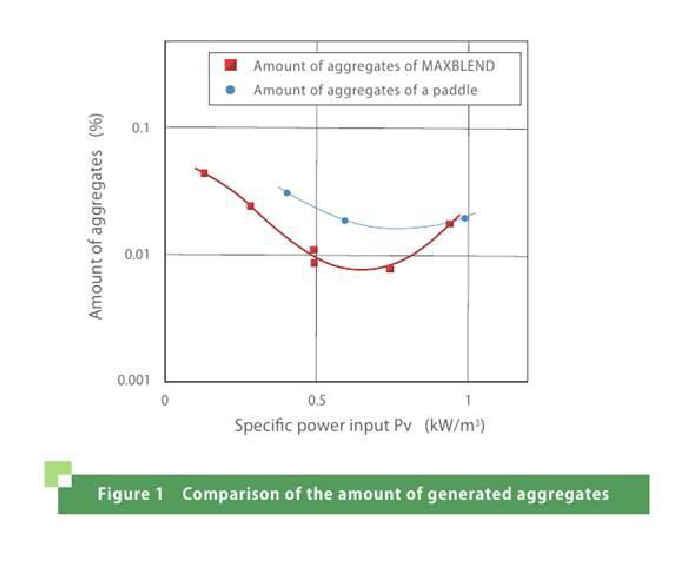
Preventing aggregate generation is an important factor in the ABS emulsion polymerization process. Figure 1 compares the amount of aggregates generated by a conventional 2-stage paddle and MAXBLEND. Despite its smaller impeller surface, the paddle generates more aggregates than MAXBLEND across a wide power range. This comparison demonstrates how appropriate mixing supports agglomeration prevention in ABS polymerization.
MAXBLEND generates an entire circulating flow throughout the vessel, eliminating flow interference and thereby inhibiting the generation of aggregates.
Deposit Reduction and Clogging Prevention in ABS Polymerization
The uniform shear effect across the entire liquid volume helps achieve even product quality. MAXBLEND inhibits aggregate generation and reduces the amount of fouling inside the mixing vessel.
A smaller amount of fouling supports deposit reduction and clogging prevention, reducing vessel cleaning time and production loss. It is therefore essential to identify an operating condition that minimizes the amount of generated aggregates. Sumitomo Heavy Industries Process Equipment advises customers on optimal operating conditions.
Applications to Similar Polymerization Processes
MAXBLEND can also be used for the following processes:
- Reduction of fouling in emulsion polymerization.
- Salting-out and acid deposition of ABS or other resins.
- Suspension polymerization of PS (polystyrene) or other resins.
Related Mixing and Support Resources
- MAXBLEND industrial agitator and high-viscosity mixing equipment – product features, mixing characteristics, and application information.
- Mixer testing and maintenance services – support for testing, impeller fabrication, maintenance, and spare parts.