


Fouling Reduction in a Mixing Vessel during BR (butadiene rubber) Solution Polymerization
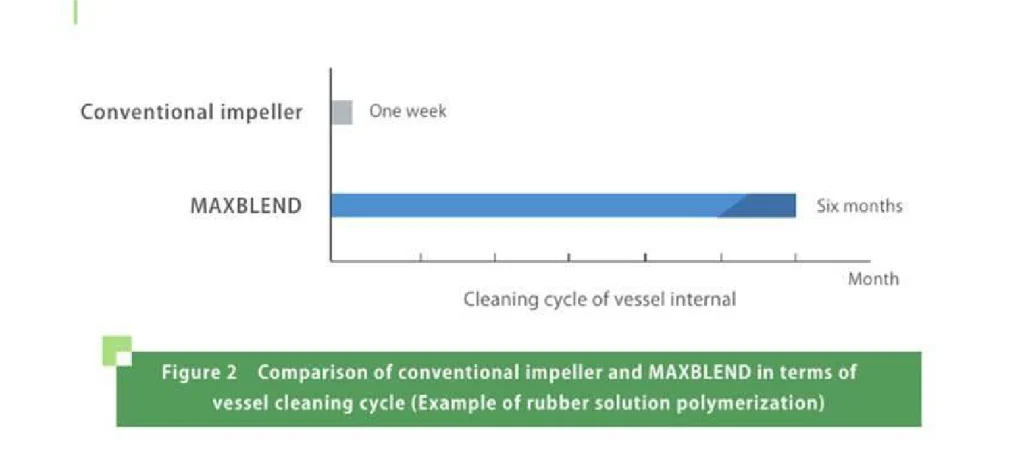
Fouling in BR (butadiene rubber) solution polymerization can build up on the mixing vessel and pipes, leading to frequent cleaning, clogging, and lost production time. This case study explains how MAXBLEND generates an entire circulating flow throughout the vessel to reduce weak-flow areas, inhibit gel and aggregate formation, and, in a commercial production case, extend the vessel cleaning interval from one week to six months.
CHALLENGES
Common Fouling Issues in BR Solution Polymerization
- Significant fouling on the polymerization vessel and pipes requires frequent cleaning and consumes substantial non-production time.
- Fouling can clog the liquid transmission pipe.
- Fouling often occurs in weak-flow areas.
SOLUTIONS
Mixer Capabilities Required to Improve Productivity
- Generate strong flows uniformly along the wall of the mixing vessel, including the bottom and top surfaces.
- Eliminate flow interference and dead spaces within the mixing vessel.
Table of Contents
What Is BR (Butadiene Rubber) Solution Polymerization?
Solution polymerization is the major BR production method because of the handling of the catalytic agent and the removal of reaction heat. BR is prone to generating gel and scale, and this tendency becomes more significant when a poor solvent is used. Effective fouling reduction in the polymerization vessel and pipes is therefore essential for preventing clogging and maintaining good productivity.
Common Fouling Issues in BR Solution Polymerization
- Significant fouling on the polymerization vessel and pipes requires frequent cleaning and consumes substantial non-production time.
- Fouling can clog the liquid transmission pipe.
- Fouling often occurs in weak-flow areas.
Mixer Capabilities Required to Improve Productivity
- Generate strong flows uniformly along the wall of the mixing vessel, including the bottom and top surfaces.
- Eliminate flow interference and dead spaces within the mixing vessel.
How MAXBLEND Supports Fouling Reduction in the Mixing Vessel
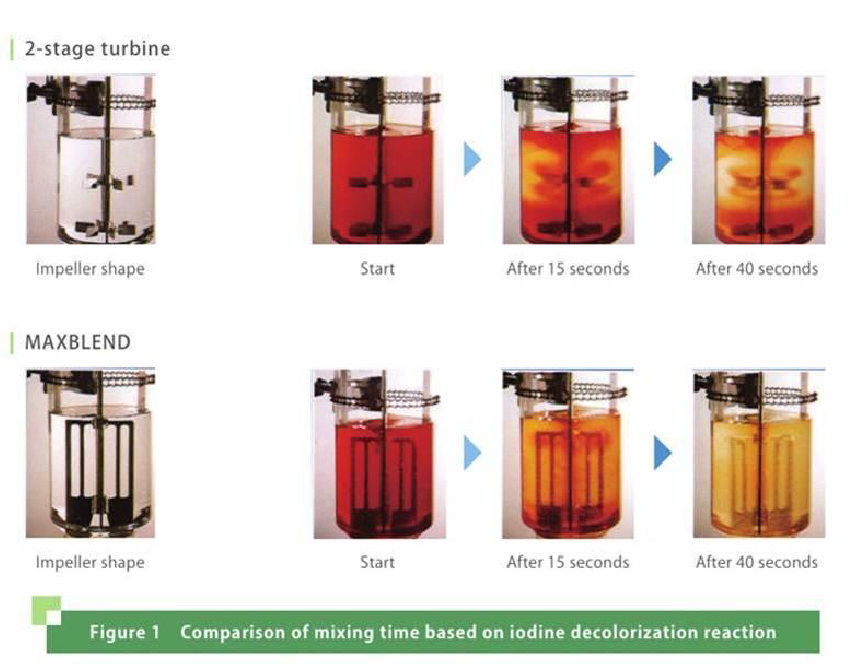
A general multi-stage impeller can create mutual interference between generated flows, allowing weak-flow areas to appear and resulting in fouling.
Figure 1 compares a 2-stage turbine and MAXBLEND based on how decolorization progresses over time. With the 2-stage turbine, decolorization is slow in the bottom area. MAXBLEND generates an entire circulating flow throughout the mixing vessel, eliminating flow interference and applying shear force uniformly within the vessel. This produces even product quality, inhibits the generation of gel and aggregates, and significantly reduces fouling inside the mixing vessel.
Deposit Reduction and Cleaning Interval Improvement with MAXBLEND
In a commercial production case, MAXBLEND extended the vessel cleaning interval from one week with a conventional impeller to six months. This resulted in a significant improvement in productivity.
Applications to Mixing High-Viscosity Liquids and Similar Processes
- Solution polymerization of SBR (styrene-butadiene rubber), AS (acrylonitrile styrene), elastomers, and related materials.
- Uniform mixing of high-viscosity liquids, including hair care products and silicon reaction vessels.
Related Mixing and Support Resources
- MAXBLEND for mixing high-viscosity liquids – product features, mixing characteristics, and fouling-reduction information.
- Mixer testing and maintenance services – support for testing, impeller fabrication, maintenance, and spare parts.