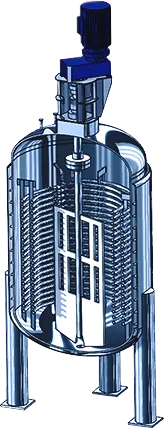
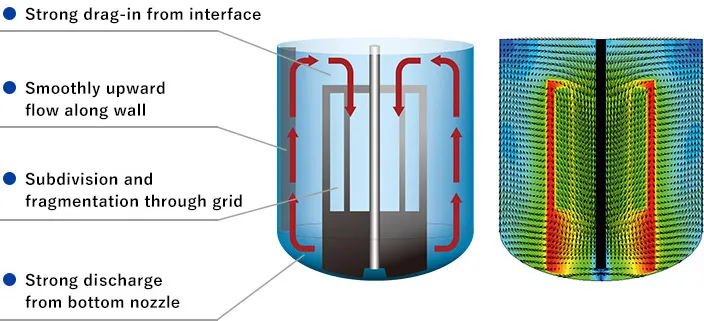
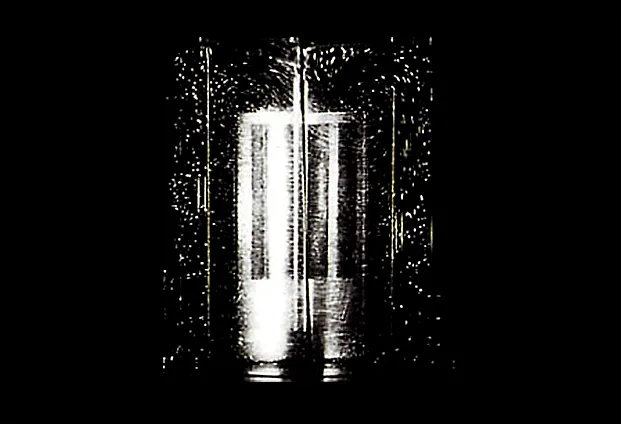
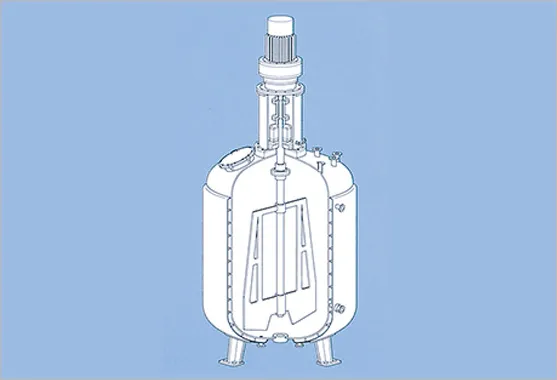
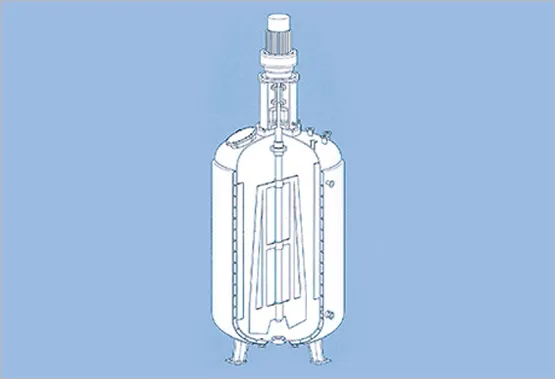
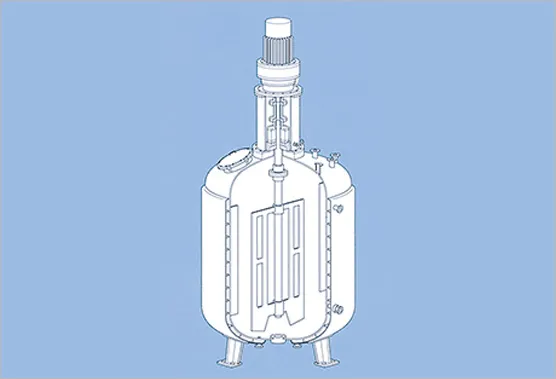
MAXBLEND generates the appropriate flow pattern based on the vertical circulating flow in the whole area of the vessel.
The upward flow is generated along the vessel wall by a strong discharge flow from the bottom paddle, and the entire circulating flow is formed in the whole area of the vessel.
Complete mixing in short time
Impeller for high viscosity
Impeller for low viscosity
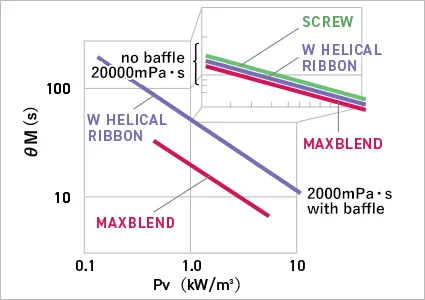
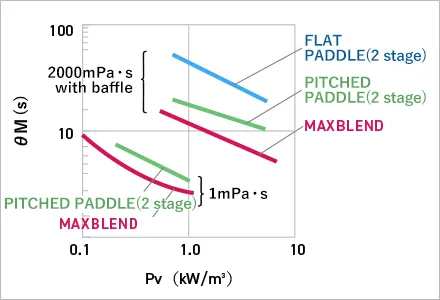
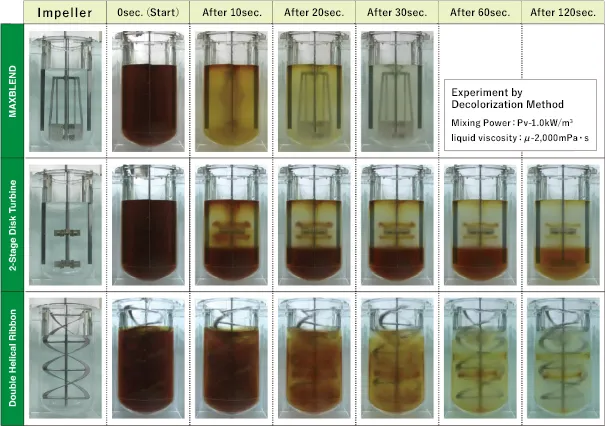
The homogeneous mixing in short time is enabled by the ideal flow pattern as compared with the previous impeller models. The graphs on the right show on the right the relationship between the mixing power and complete mixing time.
If the mixing power is as shown on the right, the homogeneous mixing is enabled in short time. These graphs indicate the excellent mixing characteristics of MAXBLEND that requires only a lower power to obtain the mixing status of the same level.
Comparison of mixing time
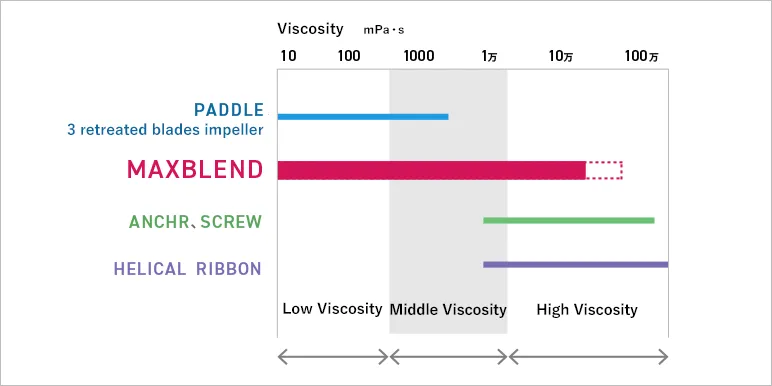
Applicable wide viscosity range
As compared with the general impeller models, MAXBLEND has stable mixing performance for a change of the viscosity, therefore, it is optimum for operations with the viscosity changed or a production of many products that have the different viscosity for each product.
Applied viscosity range
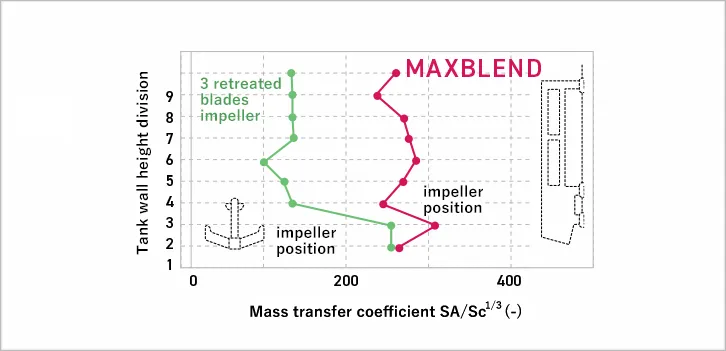
Stable flowing characteristics
Distribution of tank wall mass transfer coefficient
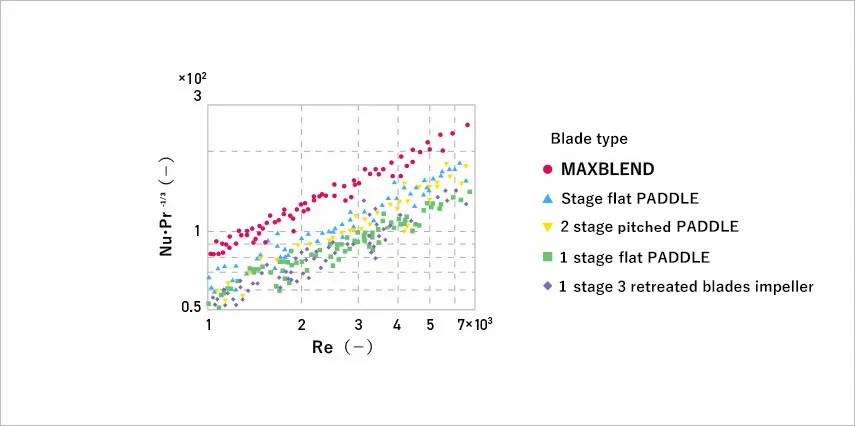
MAXBLEND provides a high heat transfer coefficient by applying the strong and homogeneous circulating flow in the wall surface area, and also resolves an unstable heat transfer or unhomogeneous temperature in the vessel wall height direction, which are problems with the conventional multi-stage impeller models.
Excellent heat transfer characteristics
Relationship of Reynolds number and heat transfer coefficient
The homogenization of the temperature in the vessel is easily attained in a short time by a combination of the excellent heat transfer characteristics and mixing characteristics.
As shown in the graphs, MAXBLEND can hold high heat transfer characteristics in the wide Reynolds number range.
Stable performance not affected by a change of the liquid level
In a multistage impeller, if the liquid level is changed, it leads to a imbalance in the fluid flow derived by each impellers, so it is not appropriate for operations that lead a change of the liquid level. MAXBLEND, consists of impellers arranged successively in the height direction, provides stable performance that is not affected by a change of the liquid level. It is optimum for operations that cause a change of the liquid level, for example, material dripping, additional charge, and product pull-out processing. The movie below show the homogeneous dispersion and floating substance involvement caused by a change of the liquid level, which are compared between MAXBLEND and general impeller.
Comparison of suspension characteristics in liquid surface
change conditions
Mixing conditions:
MAXBLEND
N=130rpm Pv=0.5kW/m3
2-stage Turbin
N=255rpm Pv=0.5kW/m3
Fluid: Water Solid: Resin 0.5wt%
Homogeneous solid suspension
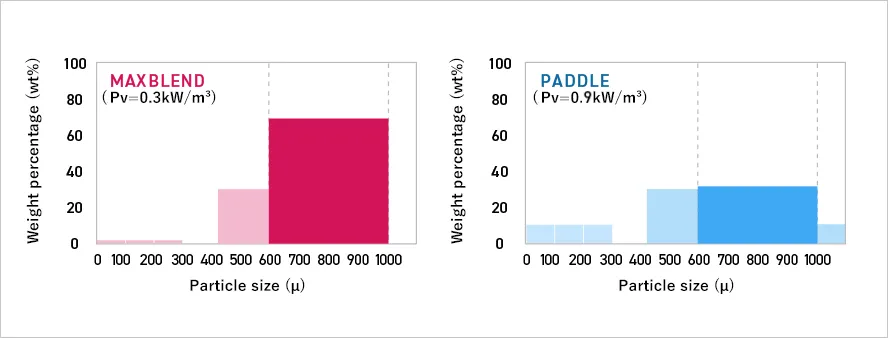
Particle size distribution after 18 hours operation
The graphs show the particle size distribution, which has obtained after 18 hours operation at the just-suspension power input.
Solid particles can be floated evenly in the entire vessel by a low rotation and low power using a strong discharge flow from the bottom of the vessel. No local shearing area is required near the impeller dislike the paddle impeller, minimizing the physical crushing of solid particles.
Few fouling
Example of rubber solution polymerization
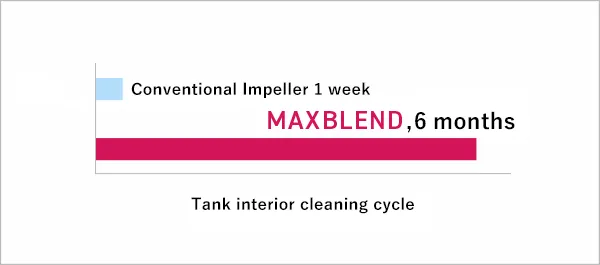
The stagnant are resolved, and the uniform shear force is ensured in the vessel. MAXBLEND generates homogeneous product characteristics and inhibits the occurrence of gelling stuffs or aggregates, excessively reducing the amount of fouling on each part in the vessel.
Simple control of crystal size
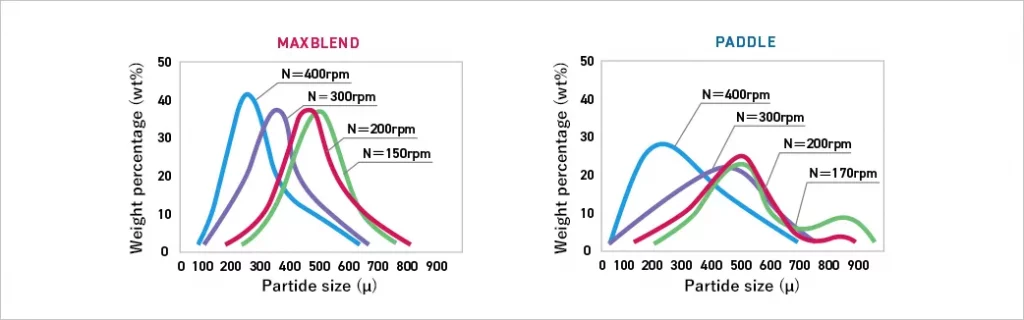
Produced particle size distribution
As compared with the paddle impeller, uniform shear are applied to the entire fluid in the vessel. Therefore, the particle size distribution by suspension polymerization or crystallization is maintained sharply. Furthermore, the crystal size control can be attained easily by a speed variation. The graph shows the comparison with the paddle impeller.
Excellent gas-absorption characteristics
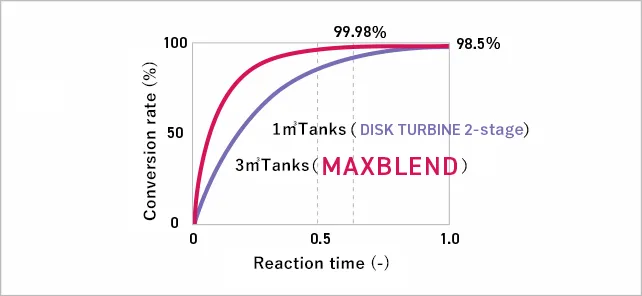
Comparion of hydrogen reaction-rate
MAXBLEND, which has the excellent gas involvement performance from free liquid surface, offers the excessive reduction of the reaction time and the enhancement of the final reaction rate as compared with the previous impeller model.
Comparison of gas distribution
Energy savings in agitation
Energy saving
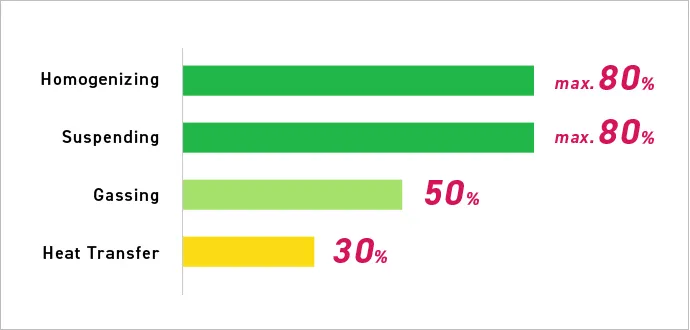
Ideal flow pattern enables mixing with little power. In solid-liquid conditions, we can reduce energy requirements by up to 80 % compared with the general impellers. In addition, MAXBLEND has excellent properties in liquid-liquid and gas-liquid.
Functional Lineup to Meet User Needs
We design and offer the optimized MAXBLEND impeller shape suited to your needs using our highly developed and diversified processes.
M/B-W type
Functional Lineup to Meet User Needs
Even if high viscosity is advanced, a primary circulating flow with a high peak is formed, enabling uniform mixing in the vessel. During actual operation, a reduced secondary circulating flow (collateral circulation flow) results in effects such as a reduction of attached substances or abnormal reactants, or uneven heat transfer.
M/B-R type
For high liquid depth MAXBLEND
This impeller circulates liquid in one flow, from the vessel bottom to the liquid surface, by up to 2.5 times the liquid depth of the vessel diameter ratio, enabling quick homogeneous mixing in the vessel.
M/B-G type
For aerated mixing MAXBLEND
This impeller realizes both high shear characteristics (to fine bubbles) and high circulation characteristics (for efficient gas hold-up), enabling a high level of gas absorbability that was impossible with conventional impeller models.
MAXBLEND impeller
MAXBLEND generates the appropriate flow pattern based on the vertical circulating flow in the whole area of the vessel.
The upward flow is generated along the vessel wall by a strong discharge flow from the bottom paddle, and the entire circulating flow is formed in the whole area of the vessel.